
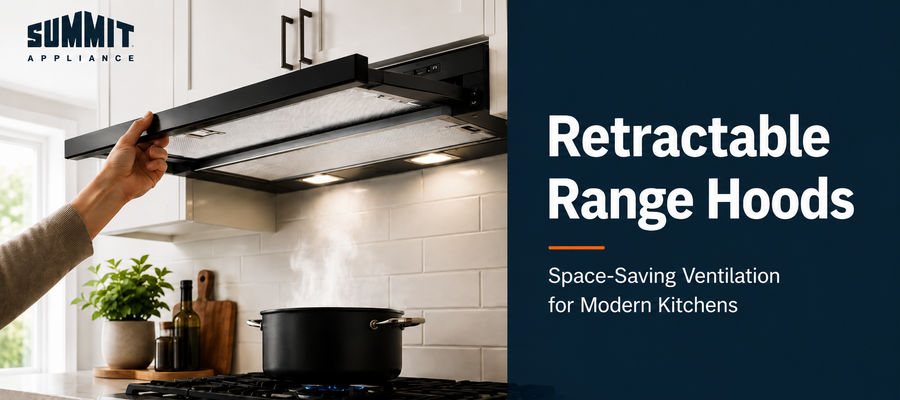
In kitchens across the world, range hoods play an essential role in maintaining a clean and comfortable cooking environment.
Whether ducted or recirculating, range hoods are designed to remove smoke, odors, grease, and airborne particles created during cooking. The key difference lies in how that air is handled once it’s captured.
Understanding the Difference In Range Hoods
Traditional range hoods are ultimately designed for ducted installation, meaning cooking air is pulled upward and vented outside the building through ductwork. This direct airflow path allows smoke and odors to leave the kitchen entirely, delivering efficient ventilation and consistent performance.
However, many spaces, particularly apartments, condos, and retrofit kitchens, do not have access to exterior ducting. In these cases, hoods are often converted to ductless operation.
A standard conversion typically involves sealing the duct openings and redirecting air through front-facing louvers after passing it through filters. While functional, this approach introduces a challenge: most traditional hoods rely on axial fans designed for straight, vertical airflow. Blocking the duct disrupts this intended air path, creating turbulent airflow and back pressure inside the unit. This turbulence can lead to:
- Reduced airflow efficiency (lower effective CFM)
- Increased operating noise
- Additional strain on the fan motor, potentially shortening product lifespan
- Limited filtration surface area, resulting in more frequent cleaning and maintenance
In short, a hood converted to recirculating operation use may not perform at the standard that hoods made for ducted applications.
Introducing Innovative Ventilation: Recirculating Range Hoods
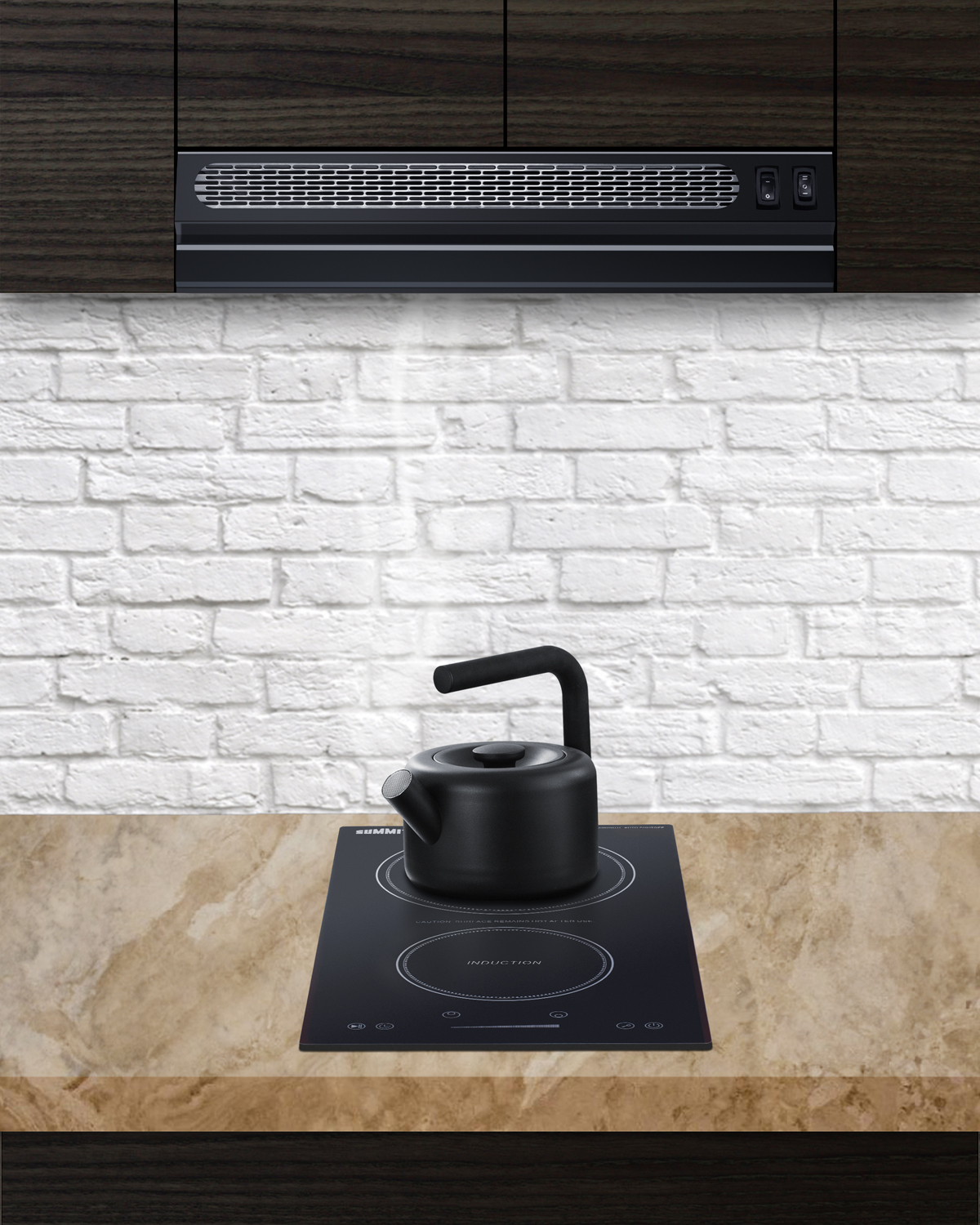
To address these challenges, Summit Appliance has introduced a new series of low-profile range hoods engineered specifically for ductless recirculating applications.
Designed and constructed in the USA, these models are purpose-built for recirculation rather than conversion. The result is quieter operation, improved airflow efficiency, and reliable performance in kitchens where ducting simply isn’t an option.
Featuring a minimalist, 4” low-profile design, these hoods integrate into any cooking area seamlessly, offering effective ventilation while maintaining a clean, flush aesthetic ideal for modern kitchens and space-conscious layouts.
Sizing That Expands Design Possibilities
Summit’s recirculating lineup also includes 18" wide under-cabinet range hoods, a size rarely offered in today’s market. While most residential range hoods begin at 24" or 30" widths, the 18" format is designed specifically to pair with slim cooktops and space-constrained kitchens often found in apartments, ADUs, office breakrooms, and small residential layouts. This narrower footprint allows proper ventilation without requiring oversized cabinetry or compromising on the original kitchen design.
By offering a true 18" solution rather than scaling down larger models, Summit provides an option that better aligns with compact cooking spaces where every inch matters, delivering practical ventilation while maintaining proportional aesthetics.
Additional Ventilation Solutions from Summit
Alongside its innovative retractable and ductless-focused designs, Summit Appliance offers a full range of ventilation solutions to suit diverse kitchen needs:
- European-style wall-mounted range hoods
- Convertible under-cabinet range hoods
- Over-the-range microwave ventilation systems
- Shell hoods for a conventional and finished look
Browse Summit Appliance’s complete collection of ventilation solutions to find the right hood for your kitchen.